

How to Know if the cannabis Is Good Before Buying It in 2026
Knowing good cannabis is not just about the terpenes and THC for the experience. It’s about safety, too. A 2023 study looked at 60 batches from medical dispensaries, and guess what? Approximately 25% of them had unsafe mold levels, over 10,000 specks per gram, with the worst hitting 1.2 million. That’s really bad, especially since some spores can cause lung infections. New regulations were introduced in 2026 to help prevent this health risk. But, how do users know if cannabis is “good”? Not just good for enjoyment, but also good for safe consumption? Read our buyers’ guide for 2026 to build your own checklist!
Key Takeaways
- Freshness determines the quality, not the THC potency. Check the harvest or packaging date. Terpenes fade, so newer batches usually taste and feel better.
- Examine the buds. It should look frosty (trichomes), feel slightly springy, and smell rich and complex.
- Lab testing matters. Tested cannabis is screened for pesticides, mold, and heavy metals. That’s a safety layer that should be a must for all good cannabis.
- Storage quickly impacts quality, or it does so over time. Heat, light, and air break down terpenes. Proper storage and handling are crucial.
- Shop by terpene profile, not just strain name. In 2026, strain names have become a budtender legacy. It’s best to recognize terpene patterns to nail the experience you’re aiming for.
What Does "Good cannabis" Mean in 2026?
How Has Cannabis Quality Changed Over the Years?
A premium cannabis in the 1970s will be a different species from a dispensary-grade cannabis you’d purchase in 2026. Today, quality isn’t defined by “strength” alone, but by precision.
Higher potency: Advances in cannabis production have led to sinsemilla, a method of seedless cannabis cultivation. It became easy for manufacturers to increase THC levels from an average of 4% in 1995 to 20-30% in 2026.
Better Profile: Preservation has improved significantly. The trichomes remain intact due to “no-touch” automated trimming and climate-controlled curing. You won’t find any seeds mixed with your stash because of this.
Obvious purity: Decades ago, cannabis users had no way of confirming their cannabis was free of contaminants. Today, various laboratory methods can detect pesticides, heavy metals, mold, and other contaminants.
What Factors Decide Cannabis Quality Today?
In the 2026 market, the idea of “quality” is no longer just a feeling but a set of verifiable data.
Terpene-first mindset: Instead of going for cannabis that’s high in THC, savvy consumers are asking specifics about the terpene profile. An elite cannabis flower boasts a 3% total terpene benchmark.
Trichome-loaded: The sticky resin glands are a variable in the equation, not only for manufacturers, but for users. More trichomes mean richer flavors and a deeper experience. High-quality trichome heads should be milky white or slightly amber.
Lab-tested: A product is considered “good” or safe only if its Certificate of Analysis (COA) shows microbial purity and zero moisture content.
Why Do Old Rules Do Not Always Apply Anymore?
So many myths have been debunked because of the existence of cannabis research.
Myth for decades: Sativa for energy, Indica for “in-da-couch” relaxation.
The 2026 Reality: Botanical experts and lab data confirm that these terms accurately describe the plant’s physical shape. They do not reflect their effects on your brain.
Myth for decades: Higher THC = Better cannabis.
The 2026 Reality: Researchers say that higher THC levels can lead to receptor saturation. This means that once you hit a certain point, taking more THC won’t make you feel “higher.”
How Can You Check Cannabis Quality Before Buying?
What Are the First Things You Should Look At?
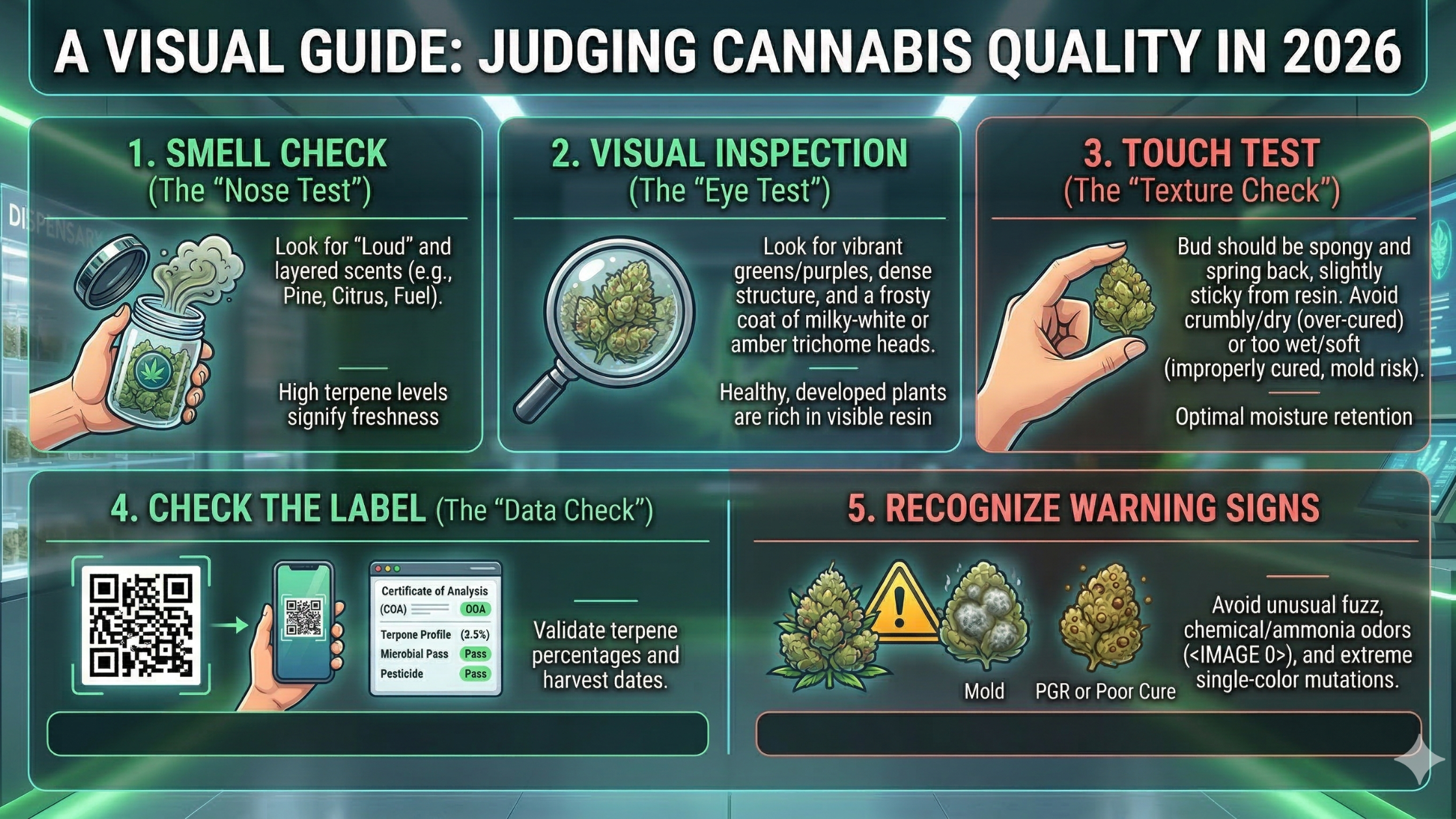
What probably stuck for decades: your eyes and hands are still your first line of defense with cannabis flowers. There are the so-called biological markets that dictate what a good cannabis is.
Look for vibrant lime greens and bright orange or red hairs (pistils). No brown, tan, or dull-colored colors. For certain strains, specific colors must appear. For Blue Dream, for example, it must display subtle shades of blue or purple.
Look for milky white or cloudy trichome heads. This signifies peak terpene development and THC potency.
The bud structure must appear firm yet delicate, the easy-to-snap kind (due to moisture loss).
Can You Judge Cannabis Quality Without Smoking It?
Yes. In addition to visually assessing trichome integrity and overall nug color, you can perform a “touch test.” Quality buds should be spongy and bouncy. It should also feel a bit sticky or tacky. If it’s wet, you risk exposure to mold. Or if it crumbles, it’s likely low in terpenes.
What Mistakes Do Buyers Often Make?
- The biggest mistake in 2026 is thinking a higher THC % means a better high.
Pro-Tip: Strains with middle-range THC potency often have more room in their chemical profile. This means they can hold more terpenes, which drive flavor and effects, as well as minor cannabinoids.
- Customers often come in seeking Sativa for an energy boost or Indica for sleep.
Pro-Tip: It’s better to shop by terpene profile. Myrcene (dominant in Sativa) is believed to promote physical relaxation. Limonene (common in Indica) gives bursts of energy.
- Customers are misled by the extra-vibrant colors of the flowers in marketing.
The Reality: Certain synthetic plant growth regulators have been detected in unregulated cannabis markets in the past. This is to speed up production and create “monster buds” because of high demand. PGR-treated cannabis often has a muted aroma, fewer trichomes, and more pistils.
Does the Smell of Cannabis Matter Before Buying?
What Does Fresh Cannabis Usually Smell Like?
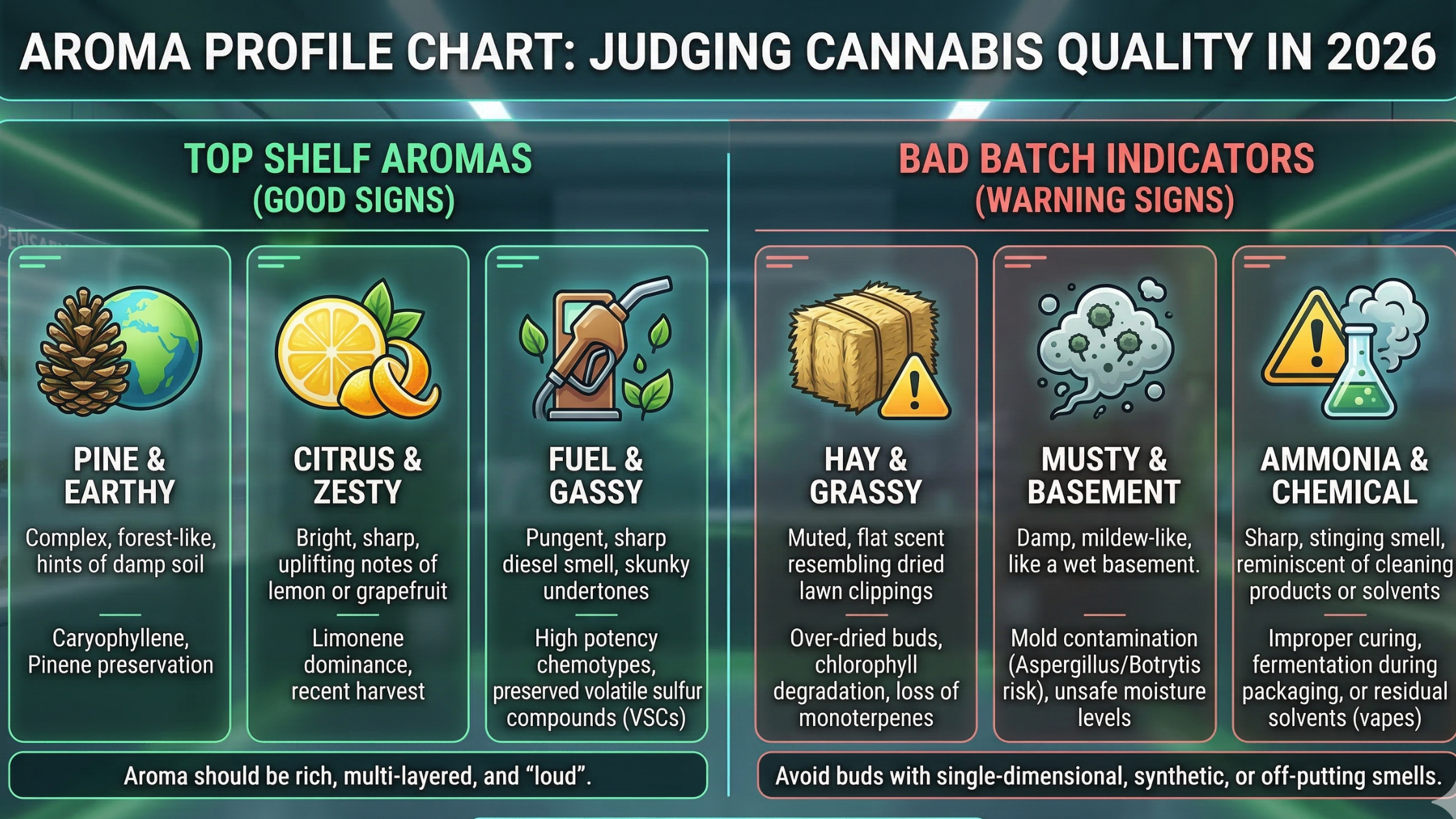
Cannabis considered “loud” in 2026 is fresh and of superior quality, with an aroma so powerful it can be smelled from inside the jar. A complex, layered fragrance, as opposed to a one-dimensional odor, defines freshness. Just like in fragrance, there are top, middle, and base notes. In 2026, these deep scent profiles are more deeply embedded in genetics. For example, a fresh Amnesia Haze will smell like lemony earth, and a fresh Wedding Cake will smell like a sweet dessert.
Which Smells Are Warning Signs?
When a flower emits an unusual odor, it often indicates that curing has gone wrong or that harmful microbes are multiplying. In 2026, your nose is your best defense against bad batches. Some signs to note:
An ammonia scent usually means the cannabis was packaged while still moist.
A musty or “basement” smell indicates the flower is moldy or almost rotting.
A hay-like smell suggests the flower is old. Meanwhile, a smell like freshly cut grass indicates it’s immature.
Your skin contains endocannabinoid receptors as part of the broader endocannabinoid system throughout your body. When you apply a THC topical, the THC molecules bind to these receptors in the skin and surrounding tissue.
Can Weak Smell Mean Low Quality?
Yes. Cannabis usually has a strong smell. This is because it contains terpenes, volatile sulfur compounds, and other fragrant compounds. When it has a faint, muted, or bland smell, it’s likely that the chemical signatures of the aroma have already degraded. Another reason is that the compounds hadn’t fully developed at the time of flower harvest.
How Does Touch Help You Judge Cannabis Quality?
Should Good Cannabis Feel Sticky or Dry?
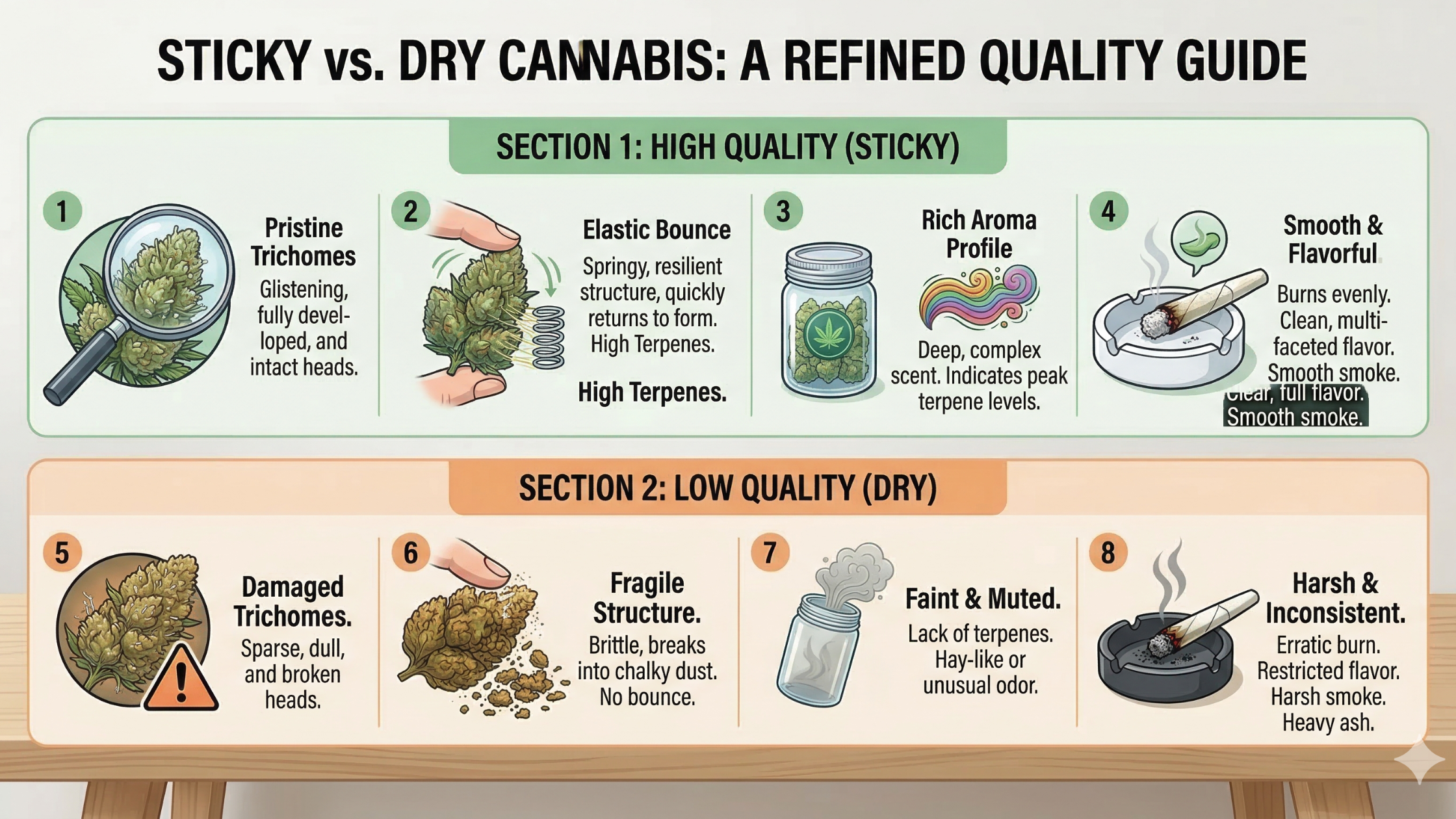
It should feel sticky for it to be considered fresh and potent. High-quality cannabis is covered with a microscopic layer of mature resin glands. When you handle premium buds, it can be tough to break apart. This is due to its high trichome density. As you press it, you’ll see a coating like powdered sugar pulling away. This reveals the soft center inside.
What Does Crunchy Cannabis Mean?
You’ll never hear a connoisseur describe his favorite flower as “crunchy”. When a bud is dry to the touch and crackles easily rather than resinously snapping, it’s obviously not fresh anymore. Crunchy cannabis usually signals over-drying. When the flower becomes brittle, volatile monoterpenes evaporate first. Bland aroma, bland flavor. The moisture likely dropped too low during storage. Overdried buds burn faster, taste harsher, and may feel less nuanced in effect.
Can Soft Buds Be a Bad Sign?
Soft doesn’t always mean bad. Some phenotypes of Runtz or Blue Dream naturally lean toward an airy or plush structure. In fact, when it’s resinous, it should be marshmallow-y soft inside. It’s pillowy, and it bounces back. But note not to the point where it’s too wet. When it’s too soft and spongy, curing may not have been done properly or completely. This increases the risk of microbial contamination over time.
What Role Do Terpenes Play in Cannabis Quality?
What Are Terpenes in Simple Words?
Terpenes are what make cannabis smell distinct, rich, and complex. It’s what makes a strain feel different from another strain (aside from THC). They’re the natural aroma oils inside the tiny crystal glands (trichomes) on cannabis flowers. When you crack open a jar and get hit with citrus, gas, or pine. That’s terpenes, not THC.
In 2026, “good cannabis” increasingly means: preserved terpene content, clear terpene labeling, chemotype consistency, & aroma that matches the tests.
How Terpenes Affect Flavor and Effect
Terpenes shape not only the flavor and aroma, but also the cannabis’s effects. When you light up a joint, it’s the terpenes that evaporate quickly, which reach your senses instantly. The vaporized terpenes travel into your nose and into your brain. Regarding first impressions when evaluating good cannabis, terpenes are the key factor. Once they’re in the bloodstream, every terpene may influence receptors differently:
Caryophyllene may interact with CB2 receptors in the body’s endocannabinoid system
Linalool can likely interact with the GABA-A to produce anxiolytic-like effects, per a clinical study
Myrcene shows muscle-relaxant potential in animal models
Can Terpene Labels Help Buyers in 2026?
Yes. Terpene labels can predict the experience. In addition, they are a must as regulators require such transparency. These are not pure marketing copies; they are lab-verified chemical analyses needed for public safety. As for identifying effects, here’s the trick advanced buyers use:
Don’t chase strain names; rather, track terpene patterns. This requires trial and error and keen observation. For instance, during your rotation, you’ll encounter typical terpene combinations, and that’s likely what you should search for in your subsequent pursuit of a new cross.
The total terpene percentage indicates freshness and the quality of post-harvest handling. In many licensed markets, flower testing above 2% total terpenes tends to retain stronger aroma expression, though quality also depends on freshness and storage.
How to Spot Bad or Unsafe Cannabis Before Buying?
Signs of Mold or Contamination
Visually, mold may appear as white, gray, or powdery fuzz that looks different from crystalline trichomes. Trichomes sparkle and appear symmetrical under light. Mold looks webby, dusty, or irregular. If a bud smells musty (like damp hay or a basement), that’s another warning sign.
Laboratory screening for organisms such as Aspergillus species is required because of inhalation risks.
Chemical or Fake Smells to Avoid
A solvent-like smell (resembling paint thinner or plastic) is a major red flag, particularly in vape products. An ammonia-like odor may indicate improper curing. During slow drying, chlorophyll and residual moisture must break down gradually. Lastly, in 2026, artificially enhanced aromas have become a growing problem.
Watch out for these inorganic and harmful signs. Legal dispensaries sell products tested for residual solvents and moisture content, whereas unregulated products may not be.
Packaging Red Flags You Should Not Ignore
In 2026, compliance is your first safety filter. Regulated cannabis packaging follows strict compliance standards. Red flags include:
- No batch identification
- No harvest or packaging date
- Generic bulk bags with no producer label
- Broken safety seals
- Faded or inconsistent labeling
- Packaging that isn’t child-resistant
Cannabis degrades over time, so always check the date.
Does the Seller or Dispensary Matter?
Yes. Quality control continues in retail. It doesn’t stop at cultivation and manufacturing.
How Trusted Sellers Handle Quality?
Good dispensaries handle cannabis the way grocery stores handle fresh produce.
Cannabis is a perishable product. It has a best-before or expiration date. Retailers need to track the packaging date and use a systematic approach (e.g., FIFO, first-in, first-out).
Good cannabis degrades when they’re exposed to extreme light, heat, and oxygen. Dispensaries own climate-controlled storage (with around 55–65% RH) to stabilize the condition of cannabis goods until your next purchase.
Why Street Cannabis Is Riskier in 2026?
You shouldn’t buy from the street because there is no required testing, batch tracking, or recall system in place. Regulated supply chains matter for cannabis to avoid risking public safety. In each state, a designated cannabis authority ensures all products are safe for consumption. Product should pass the test for the following, among others:
- Allowable mold and yeast limits
- No pesticide or other microbial contamination
- Correct labeling (no false or misleading claims)
Questions You Should Ask Before Buying
- “When was this batch packaged or harvested”
Cannabis is perishable. Terpenes degrade faster than THC. Fresh batches typically preserve aroma and texture better.
- “What are the dominant terpenes?”
Instead of asking “What’s the highest THC?”, ask which terpenes lead the profile. This predicts experience better than THC alone.
- “How has this been stored?”
Flowers should be kept in cool, dark, humidity-stable conditions. Poor storage accelerates terpene loss and texture degradation.
- “Is this indoor, greenhouse, or outdoor grown?”
The cultivation environment affects density, terpene retention, and batch consistency.
Pre-Roll, Flower, or Vape – Does Quality Check Change?
How to Check Flower Quality Before Buying?
Step 1: Look at the structure. Whole buds should be intact. A premium nug shows defined calyx structure, visible pistils, and layered formation.
Step 2: Check trichome coverage. Under light, a quality flower should appear frosted. Those crystals are glandular trichomes. They should not look dusty, brown, or rubbed off.
Step 3: Test the trichome density and rebound. Gently squeeze. The bud should compress slightly, then spring back.
Step 4: Inspect vibrancy. Healthy flowers range from vibrant green to deep purple, depending on genetics. Dull gray tones can signal age or oxidation.
Step 5: Smell with intention. Aroma should be layered and distinct. If the aroma is muted or hay-like, it may indicate that the terpenes have degraded.
What to Check in Pre-Rolls?
Step 1: Check the Pack and Shape
Roll the pre-roll gently between your fingers. It should feel evenly packed from tip to filter. Uneven packing causes canoeing and poor airflow. Premium pre-rolls should feel structurally uniform, not compacted at one end.
Step 2: Ask What It’s Made From
Whole-flower inputs preserve more resin glands. Trim-based inputs contain more leaf matter and fewer trichomes. Beware of lower-tier pre-rolls made with leftover material that no longer meets premium jar standards.
Step 3: Check Freshness and Storage
Ask when it was packaged. If it’s been sitting for months, terpene loss is likely. Grinding increases surface area exposure to oxygen.
How Cannabis Quality Differs in Vape Products?
QA for vape products is different from that for flowers. First, look at oil clarity. High-quality distillate or resin should appear clear to amber. Very dark oil may indicate oxidation or poor refinement. Second, check viscosity. Oil should move slowly when tilted, not run thin like water. Extremely thin oil can indicate dilution. Third, verify the extraction type. For example, a Runtz live resin cartridge should preserve more of the strain’s original terpene fingerprint compared to standard distillate.
Comparison Table: Quality Checks by Product Type
| Feature | Live Resin | Distillate | Rosin / Live Rosin |
|---|---|---|---|
| Source Material | Fresh-frozen cannabis | Dried and cured cannabis | Fresh-frozen or dried flower |
| Extraction | Solvent-based (butane/propane) | Short-path distillation | Solventless (heat and pressure) |
| THC % Range | 45–90% | 85–95%+ | 50–85% |
| Terpene Content | High | Very low | High to moderate |
| flavor Profile | Complex, true-to-strain | Mild to neutral | Complex, strain-specific |
| Full Spectrum | Yes | No | Yes (live rosin) |
| Price | Mid to high | Lower | High (live rosin) |
| Best For | flavor and full-spectrum experience | High-potency, consistent output | Solventless preference, flavor |
How Should Good Cannabis Be Stored After Buying?
Best Storage Conditions for Freshness
Keep it in a cool place. Ideally, it should be stored at a temperature range of 60–70°F (15–21°C). Fun Fact: THC oxidizes into CBN when there’s enough heat present.
Follow the standards for humidity-control products. Cannabis stored at ~55–62% RH reduces microbial growth risks and preserves its texture.
Choose an airtight glass as a container. Glass is non-porous and chemically stable. The original packaging is usually a pop-top plastic jar. They are not fully airtight and thus allow for microscopic oxygen exchange.
What Ruins Cannabis Quality Over Time?
Repeated opening. Each time a jar is opened, oxygen enters, and volatile compounds escape. Over weeks, that adds up, and the terpenes dull.
Repeated handling. Trichome heads are fragile. They sit on thin, dried stalks and can rupture or detach when subjected to excessive mechanical movement.
Nose Blindness. Sometimes, a temporary decrease in odor perception occurs after repeated exposure to the same scent. This occurs not just in fragrance science but also in cannabis consumer science.
Common Storage Mistakes Buyers Make
Storing a small amount of cannabis in a large container. When it comes to empty space, there’s more empty space for oxygen to penetrate. This limits the protection from oxidation.
Using thin plastic bags for storage. Plastic is semi-permeable. You’ll likely end up exposed to some oxygen, but plastic also attracts static electricity, which will pull down loose trichomes into the bag.
Opening the jar too often. Most cannabis products are stored in opaque containers to protect against light. You might be tempted to check it often to make sure it hasn’t gone. Be warned: each time you open it, it lets more oxygen in.
Final Thoughts
What is good cannabis in 2026? It’s cannabis that is fresh, properly cured, terpene-rich, lab-tested, and stored in stable conditions. In today’s market, quality means preserved chemistry, transparent testing, and consistent handling. It’s not just high potency.
FAQs
How can I tell if cannabis is good without smoking it?
Start with the trichomes. Those resin glands carry cannabinoids and terpenes. Under light, they should look frosted and intact. It’s not dusty or rubbed off. Gently squeeze the bud. It should rebound, not crumble. Smell next.
What color of cannabis should I avoid?
Avoid dull gray, brown, or overly pale flowers. Healthy cannabis ranges from vibrant green to deep purple depending on genetics. Brown discoloration may signal oxidation or age. Excessively dark or dusty buds can indicate mold or improper curing. Color alone isn’t proof.
Is a strong-smelling cannabis always good?
A pronounced aroma usually indicates terpene preservation. That’s important because terpenes shape flavor and experience. But intensity should match chemistry. Sharp, solvent-like smells signal curing or additive issues. Aroma should feel botanical, not synthetic.
Does expensive cannabis mean better quality?
Price reflects cultivation inputs, branding, and market demand. Quality shows up in batch freshness and terpene retention. A mid-priced batch of Lemon Cherry Gelato harvested recently can outperform an older premium jar. Ask about harvest date, storage conditions, and terpene totals. Chemistry and handling determine value more reliably than shelf tier.
How long does good cannabis stay fresh?
Properly stored cannabis stays chemically stable for about 3–6 months. Terpenes degrade first, often within weeks if exposed to air or heat. THC degrades more slowly. Airtight glass, cool temperatures, and stable humidity extend freshness.
Is lab-tested cannabis safer to buy?
Yes. Lab-tested cannabis is screened for pesticides, heavy metals, microbial contamination, and potency accuracy. Regulated states require batch-level testing. Informal markets lack mandatory testing or recall systems.